

How Data, Behavior, and Infrastructure Come Together to Shape the Future of Urban Flight
The promise of Advanced Air Mobility (AAM) has captured global imagination: electric aircraft rising quietly above congested streets, whisking passengers across cities in minutes rather than hours. But behind this futuristic vision lies a far more grounded, rigorous question—where will people actually fly, and how often? For vertiport operators, this is the cornerstone of the entire ecosystem. Infrastructure must be built not on hope, but on measurable, validated demand.
At Vertiports by Atlantic, our approach to understanding that demand is both analytical and pragmatic. It blends billions of datapoints, behavioral economics, mobility patterns, and real world bottlenecks. And while the future of urban flight is exhilarating, the path to getting there begins with something far less glamorous: data. Lots of it.
The Journey Begins: Mapping How Cities Really Move
Demand forecasting in AAM starts with an honest look at how people travel today. Cities are complex organisms, each with their own pulse, routines, and constraints. To tap into that rhythm, we rely on mobility data at massive scale—more than 200 billion datapoints from over 80 million tracked devices, revealing real origin destination flows, peak hour bottlenecks, and seasonal trends.
This isn’t just about counting commutes. It’s about reconstructing entire mobility ecosystems: where people start, where they end, how long their journeys take, and what alternatives they consider. From this, a picture emerges—not of theoretical demand, but of living, breathing cities whose mobility patterns evolve hour by hour.
Our proprietary analytics platform distills these patterns into dynamic maps and networks. It identifies which corridors are already strained, which communities lack efficient connections, and where time savings from eVTOLs would create irresistible value. In short, it shows us where AAM can meaningfully improve daily life.

From Data to Decisions: Understanding Who Will Actually Fly
One of the most revealing aspects of our methodology is market segmentation. People don’t travel for the same reasons, nor do they value time equally. So, we break down each potential route into dozens of micro segments based on income, trip purpose, and current travel mode—resulting in 15 to 60 unique passenger segments per route, each with its own behaviors and preferences.
This is where demand forecasting becomes almost philosophical. How much is one’s time worth? When does shaving 30 minutes off a commute feel life changing—and when is it just a convenience? Using wide-accepted guidelines for Value of Travel Time Savings (VTTS) and our own behavioral models, we estimate what passengers in each segment are willing to pay for the speed, reliability, and experience AAM offers.
From there, the story becomes a series of carefully modeled tradeoffs. Every route has a curve: where the eVTOL operator’s ticket price meets the passenger’s willingness to pay, where elasticity begins to bite, and where premium users remain resilient even at higher prices due to the value of time savings and convenience. These curves help us understand not just who might try eVTOLs, but who will become long term, predictable users. They also inform eVTOL operators about how the ticket prices they set will influence demand.

The Competitive Reality: AAM Isn’t Just Replacing Helicopters—It’s Challenging Cars
To be sure, eVTOLs will be a quieter, more sustainable and less intrusive option than today’s helicopters. As a result of these traits, they will be able to fly to many congested locations where helicopters may not be welcome by communities today.
However, AAM’s greatest opportunity isn’t to capture those who already fly—it’s to win over those stuck on congested highways or zigzagging through indirect transit systems.
That’s why every AAM route we model is benchmarked against the actual alternatives people face every day: driving costs, taxi and TNC fares, rail schedules, congestion levels, tolls, parking, and more.
When you account for lost productivity, frustration, variability, and cost, the value proposition for AAM becomes clearer—especially on corridors where time savings are significant. And because eVTOLs have fundamentally different cost structures from helicopters, the economics work best when they compete with surface transport, not legacy aviation.
This is where excitement builds. The demand is not niche. It is mainstream.
Designing the Vertiport Network of Tomorrow
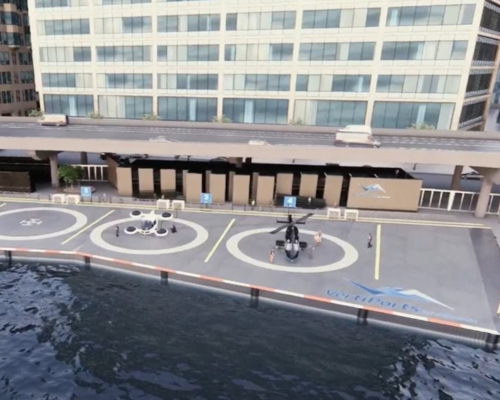
Once route level demand is understood, the implications ripple outward to infrastructure planning. Vertiports are not standalone assets; they are nodes in a carefully orchestrated network. Robust demand modeling tells us where to build, how large to build, and how these sites will work together to deliver a seamless passenger experience.
Each model iteration refines the network—sometimes confirming expected hotspots, sometimes revealing surprising mobility corridors that only emerge at scale. And because vertiport economics depend on the interplay between ticket prices, penetration rates, and landing fees, our forecasting ensures the system remains financially sustainable for all stakeholders.
AAM isn’t simply a new transport layer. It’s a new urban fabric. And vertiports are the stitching that holds it together.
A Future You Can See from Here
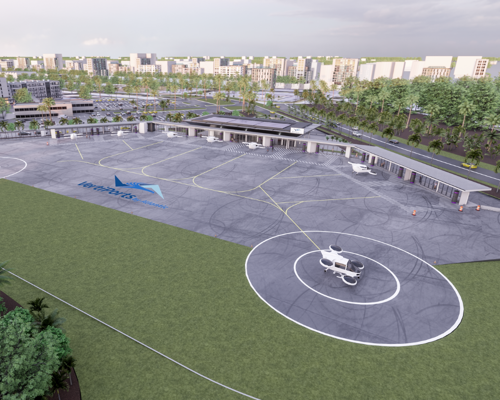
When people imagine the future of urban air mobility, they picture aircraft. What we see—through datasets, algorithms, and citywide models—is the vibrant human landscape that will make those aircraft indispensable.
We see commuters reclaiming hours of their day.
We see businesses expanding their reach across metro regions.
We see inaccessible districts becoming reachable in minutes.
We see cities where mobility is not just faster, but smarter and more humane.
This is the future that demand forecasting makes real. It transforms AAM from an inspiring concept into a meticulously planned solution grounded in measurable need.
And at Vertiports by Atlantic, we’re building that future one dataset at a time, one route at a time, one vertiport at a time—always with the conviction that when eVTOLs take to the skies, the world below should be ready.